Tender port or dock: what changes about your day ashore?
Allow for the boat transfer, access conditions and last return tender when deciding what a cruise port day can realistically hold.

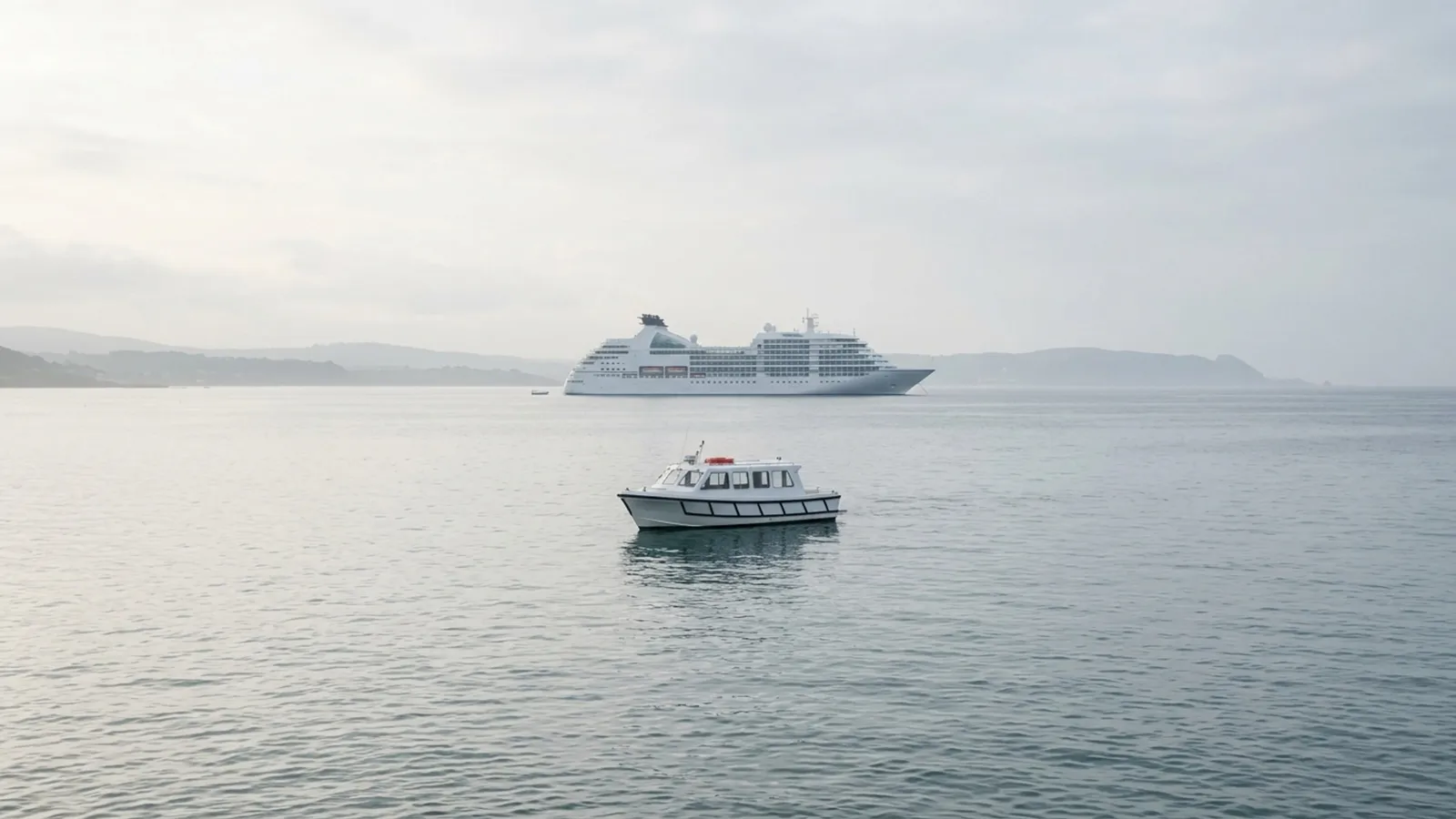
A port call marked “tender” adds a boat journey between the cruise ship and the shore. That changes how you plan the first activity, the return and the needs of anyone who finds transfers difficult. It does not automatically make the port a worse stop.
Compare the actual journey rather than treating the published arrival and departure times as hours entirely available on land. Port time and usable time ashore are different even when the ship docks.
Understand the transfer you are booking around
Royal Caribbean describes tendering as anchoring offshore and taking guests ashore in smaller boats. Its guidance also warns that a scheduled dock call can change to tendering. (Royal Caribbean offshore assistance, checked November 17, 2026.)
The practical sequence can include reaching the ship’s departure point, waiting for the transfer, boarding, the crossing and disembarking at the shore landing. On return, those stages happen again. Ask the line how its tender process works on your sailing rather than assuming the first available boat coincides with the itinerary’s arrival time.
A docked call removes that particular boat crossing, but the berth may still be some distance from your activity. The fair comparison is the complete route from ship to the thing you want to do.
Build the day around one worthwhile activity
Imagine an invented port day with a morning craft workshop on land. The workshop’s starting time is fixed, but your actual tender departure is not yet confirmed. That uncertainty matters more than whether the scheduled call looks long on a calendar.
Before paying, check how the activity handles a late arrival or a missed port. If the terms leave no useful flexibility, consider a later session or an activity you can begin after reaching shore. That is an editorial planning choice, not a prediction about the boat service.
The same method works for a museum, garden or unhurried walk. Choose a main purpose, then leave the rest of the day optional. A second attraction can be added after the return route is clear; it does not have to be part of the initial commitment.
Ask about access in concrete terms
Royal Caribbean says most tenders require guests to take steps; motorized wheelchairs and scooters cannot be taken unless roll-on capability is available, and that capability is not guaranteed. Weather and sea conditions can prevent tendering, with the captain and staff deciding on transfers for safety. (Royal Caribbean tender guidance, checked November 17, 2026.)
Those are the line’s conditions, not a description of every cruise operator or every transfer boat. Ask about the particular ship, port and equipment. Describe whether you can take steps, transfer to a seat and manage the landing, rather than asking only whether a port is “accessible.”
A companion’s willingness to help does not replace the operator’s approval. Clarify the arrangement before booking a shore activity whose usefulness depends on getting off the ship.
Establish the return deadline ashore
Find out which time is the last tender back and how it relates to the ship’s all-aboard time. Ask which clock to follow. Save the ship’s instructions and relevant contact details before leaving so a dead battery or unavailable connection does not remove the plan.
Royal Caribbean tells independent travelers to verify the onboard return time and states that the ship will not wait for guests exploring on their own. (Royal Caribbean independent exploration FAQ, checked November 17, 2026.)
Treat the tender landing as a destination you must reach, not simply a line on a map. Check how long the route back could take and what alternative exists if the planned transport fails. A fixed activity ending close to the last transfer leaves less room for ordinary delays.

Compare the excursion as a complete product
A line-booked excursion may come with a different meeting arrangement and return policy from an independently booked activity. Read that product’s instructions. Do not infer priority tender access, a guaranteed departure boat or a specific return promise merely because an excursion appears in a brochure.
For a choice between a ship tour and an independent day, compare the transfer arrangements alongside the activity itself. The guide to planning a whole arrival day uses the same principle: the connecting steps deserve as much attention as the headline experience.
Have a satisfying day if the transfer does not happen
Tendering depends on conditions. An itinerary is a scheduled plan, and a particular shore experience should not be treated as certain. Check the sailing’s terms and the activity’s cancellation rules before deciding how much nonrefundable spending to attach to that one port.
A simple onboard alternative can protect the day from becoming a total disappointment. That might be reading about the place, enjoying a quiet part of the ship or moving an optional activity to another stop. It does not make a missed port unimportant; it reduces the pressure to force every plan through.
For sailings calling near Edinburgh, the Edinburgh port guide explains why identifying the actual arrival point matters. Bucketlist’s Edinburgh page can help choose an experience only after the logistics fit.
Common questions
Is a docked call guaranteed to remain docked?
No. Royal Caribbean explicitly allows a scheduled dock call to become a tender call. Confirm the actual arrangements onboard.
Can someone who uses a wheelchair tender?
It depends on the equipment, transfer ability, boat, landing and operating conditions. Ask the line about your exact requirements; a generic accessibility label is insufficient.
Can I use the entire port-call window ashore?
No. Allow for the transfer process and the stated return deadline, as well as the trip between the landing and your activity.
Sources checked November 17, 2026: Royal Caribbean offshore and tender assistance and independent port exploration.