Compare cruise quotes: the same sailing, a different total
Two quotes for the same cruise can look far apart until you match the units and the extras. A worked example, including when onboard credit actually saves you money.

Maya and Sam have found the same seven-night cruise from two places. It’s the same ship and departure date, the same cabin category, two adults sharing, and the same fare conditions. Quote A says $900 per person. Quote B says $1,680 per cabin. B looks like the better deal.
The numbers in this guide are illustrative assumptions, chosen to show the method. They aren’t real Royal Caribbean fares or a description of how any seller displays its prices.
Put both quotes on the same footing
The two headlines are in different units. A’s is per person and, in this example, already includes the taxes and fees. B’s is for the whole cabin, with $180 of taxes and fees added on top. Before comparing, turn both into the price for everyone in the cabin, with the same charges included.
Then add the costs you’d pay on either quote. Maya and Sam plan to budget $140 each for gratuities, which neither quote includes.
| Quote A | Quote B | |
|---|---|---|
| Headline | $900 per person | $1,680 per cabin |
| Price for two | $1,800 | $1,680 |
| Taxes and fees | Included | $180 |
| Cruise price for two | $1,800 | $1,860 |
| Planned gratuities (2 × $140) | $280 | $280 |
| Comparison total | $2,080 | $2,140 |
Quote A is $60 cheaper. After converting A’s price to $1,800 for two, B’s $1,680 cabin price looks $120 lower. But B leaves out $180 of taxes and fees. Once both quotes include the same charges, the order flips.
These totals are for comparing the two quotes. They don’t tell you when each part is paid.
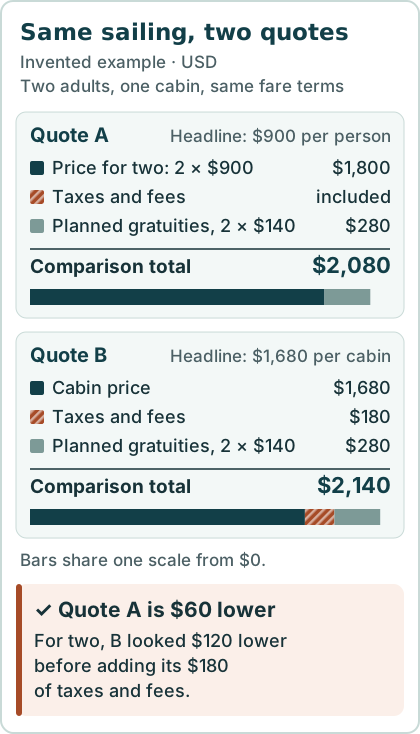
The same invented example as the table above, drawn to one scale. Each quote counts the planned gratuities once.
Count gratuities once
The $140 per person is a planning figure for this example, not a current rate. Royal Caribbean’s US ticket contract describes its service gratuity as discretionary: it’s added to each guest’s onboard account daily and can be adjusted on board. The contract also says it isn’t added automatically if your booking confirmation shows it as included in the fare, or if you prepay it.
Count the planned gratuity cost once for each option. If it’s already included in the quote total, don’t add it again. If you’ve prepaid it separately, include that payment once in your comparison total; prepaying changes when you pay, not what the trip costs. In Maya and Sam’s example, neither quote includes it, so they add the same $280 to each.
When onboard credit changes the answer
Now suppose quote B also comes with $100 of onboard credit. Maya and Sam were already planning to spend $100 on board on things the credit can pay for, at the same prices whichever quote they choose.
| Quote A | Quote B | |
|---|---|---|
| Cruise price and gratuities | $2,080 | $2,140 |
| Planned onboard purchases | $100 | $100 |
| Onboard credit used | — | −$100 |
| What they pay | $2,180 | $2,140 |
With the credit fully used on spending they’d have done anyway, B saves them $40.
The credit only counts if it replaces money you’d have spent. If they’d only use $60 of it that way, the two quotes come out the same, because $60 is exactly A’s lead. If they wouldn’t use it at all, A is still $60 cheaper. Spending money you wouldn’t otherwise have spent, just to use the credit, isn’t a saving.
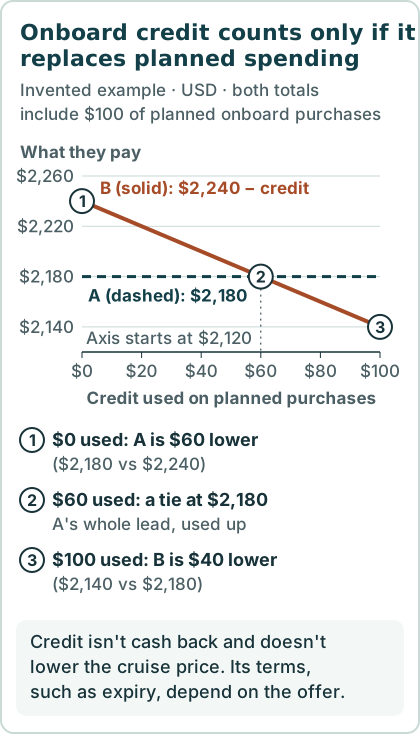
How much of B’s $100 credit replaces planned spending decides which quote costs less. The credit is never subtracted twice.
Read the terms of the credit you’re offered. In the Royal Caribbean offers we read, onboard credit had no cash value, couldn’t be transferred and expired if unused by the final night of the cruise. Some offers gave it per stateroom, and another split it between the first two guests on the booking (promotion terms). Those are terms of particular offers, not rules for every credit.
Check the quotes really match
The example assumes both quotes are for exactly the same thing. With real quotes, that’s what you need to check:
- Ship and departure date. The same sailing, not a similar one.
- Cabin category and layout. The same category code and bed arrangement. Our guide to checking the cabin layout shows what to look for.
- Travelers and units. Everyone in the cabin, and the same unit for both quotes, per person or per cabin.
- Currency and where you’re booking. Royal Caribbean’s US contract applies to guests who live in the US, while its deposit, payment and cancellation FAQ uses a booking-location test covering the US, Canada and Puerto Rico. Make sure the terms you’re reading are the ones that apply to you.
- What’s included. Taxes and fees, gratuities and anything else either quote bundles in. The contract says taxes and fees are estimated when you book and can change afterwards.
- Fare conditions. The contract lets promotional fares carry different cancellation terms, minimum-occupancy rules, non-refundable deposits or earlier payment dates. A lower price with a non-refundable deposit isn’t the same offer as a refundable one.
- The credit’s own terms. What it can be spent on, who it’s for, and when it expires.
If anything on this list differs, you aren’t comparing like with like yet. The checklist can’t prove that two real quotes match, so ask each seller to confirm anything you can’t see in writing.
What stays outside this comparison
Flights, hotels, transfers, travel insurance and shore excursions aren’t in either total here. Keep a separate wider-trip budget for those costs before deciding what you can afford. TravelTutor’s guide to cruise loyalty programs covers comparing the full cost of a sailing more broadly.
The short version
- Turn both quotes into the price for everyone in the cabin, with the same charges included.
- Count planned gratuities once, including any separately prepaid amount.
- Count onboard credit only up to what you’d have spent anyway on things it can pay for.
- Check the sailing, cabin, travelers, currency and fare conditions really match.
Prices and terms change, so keep a dated copy of each quote and the terms that came with it.